



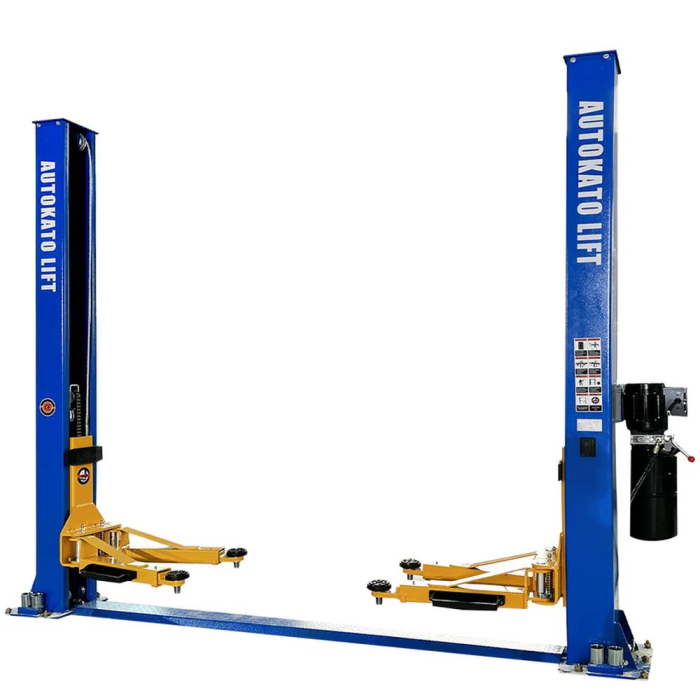
Katool KT-H105 Two Post Vehicle Lift 10,000lbs
*Concrete thickness must be at least 5.9” (150 MM) with a 3000 PSI rating. Failure to install this lift on the proper concrete could result in serious injury or death! It is the customer’s responsibility to verify concrete thickness and strength before purchase and installation.
- 10000lbs lifting capacity
- CE Approved and Certified, it has adopted 115% dynamic loading capacity and 150% static loading capacity tested.
- Manual safety release from two sides.
- Base plate design
- Dual Hydraulic Chain-Drive Cylinders
- Robber pad door opening protection.
- Screw-on pad and extension support adaptor sets +100mm
- Top-level hydraulic system with 220V/60HZ/1PH (110V/60HZ/1PH OPTIONAL ADD-ON PURCHASE $199)
Understanding Two-Post Lift Weight Capacities
Two-post lifts are essential in automotive shops, but selecting the appropriate lift with the correct weight capacity is crucial for safety and equipment longevity.
Typical Weight Capacities
Two-post lifts generally have weight capacities ranging from 7,000 to 20,000 pounds, accommodating various vehicles from light-duty cars to heavy-duty trucks. It's important to note that each lift arm also has its own weight limit. For instance, a lift with a 10,000-pound total capacity may have each arm rated for 2,500 pounds. Therefore, if a vehicle's weight distribution exceeds this per-arm limit, the lift may not be suitable.
Calculating Required Lift Capacity
To determine the appropriate lift capacity:
-
Calculate Rear Axle Weight: Multiply the vehicle's total weight by the distance from the center of gravity to the front axle, then divide by the wheelbase.
-
Calculate Front Axle Weight: Subtract the rear axle weight from the total vehicle weight.
-
Determine Arm Capacity: Divide each axle's weight by two to find the load per arm.
For example, if a vehicle weighs 9,000 pounds with a 3,000-pound front axle and a 6,000-pound rear axle, each arm would need to support 3,000 pounds. In this case, a 10,000-pound lift with 2,500-pound arms would be insufficient.Opting for a 12,000-pound lift would be safer.
Importance of Choosing a Lift with Adequate Capacity
Selecting a lift with a capacity that exceeds the vehicle's weight requirements is advisable. This accounts for variables like vehicle modifications, additional equipment, or unexpected weight distributions. Many manufacturers recommend not exceeding 75% of a lift's rated capacity to maintain safety margins.
Safe Operating Practices
-
Adhere to Weight Limits: Never exceed the lift's total or per-arm weight capacities.
-
Proper Vehicle Positioning: Ensure the vehicle is centered and balanced on the lift to distribute weight evenly.
-
Regular Maintenance: Follow the manufacturer's maintenance schedule and conduct routine inspections to identify potential issues.
By understanding and respecting the weight capacities and operational guidelines of two-post lifts, automotive shops can ensure safer working conditions and prolong the lifespan of their equipment.
| Weight Capacity | 10,000 lb |
|---|
