



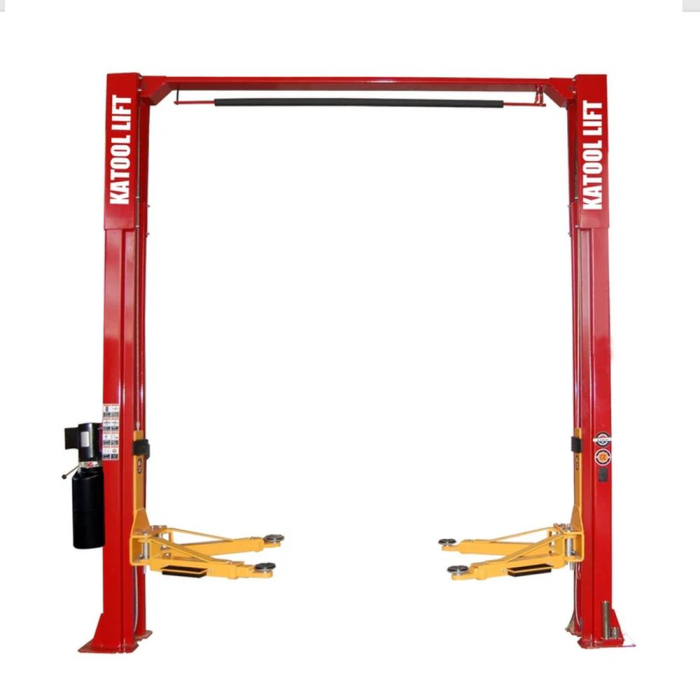
Katool KT-M110 11,000lbs Two Post Lift
Heavy-Duty Garage Power. CE-Certified Safety. Remote-Ready Performance.
The Katool KT-M110 is a robust two-post vehicle lift engineered to bring professional lifting capability to busy repair shops, performance garages, and serious home workshops. With an 11,000 lb (5,000 kg) capacity and a clear-floor design, this lift delivers smooth, balanced performance and unobstructed access for under-vehicle work—making routine service and major repairs faster, easier, and safer.
Key Features
-
11,000 lb Lifting Capacity — Handles cars, SUVs, vans, and many light trucks with confidence.
-
CE Approved & Tested — Meets strict safety standards with 115% dynamic and 150% static load capacity testing.
-
Symmetric Clear-Floor Design — Maximizes workspace under the vehicle for easier service access.
-
Dual Hydraulic Chain-Drive Cylinders — Balanced, smooth lifting performance every time.
-
Manual Safety Release (Both Sides) — Convenient and accessible safety lowering from either column.
-
Included Extension Support Adapters — +30 mm and +120 mm adapters extend compatibility for larger vehicles.
-
Rubber Door Protection Pads — Helps prevent door-edge damage during lifting operations.
-
Overhead Safety Shutoff Bar — Prevents over-travel and protects your lift and vehicles.
-
Feet-Protection Guardrails & Tool Box — Built-in shop safety and convenient storage.
-
Flexible Power Options — Standard 220 V / 60 Hz / 1 PH with 110 V / 60 Hz / 1 PH optional for varied shop setups.
Understanding Two-Post Lift Weight Capacities
Two-post lifts are essential in automotive shops, but selecting the appropriate lift with the correct weight capacity is crucial for safety and equipment longevity.
Typical Weight Capacities
Two-post lifts generally have weight capacities ranging from 7,000 to 20,000 pounds, accommodating various vehicles from light-duty cars to heavy-duty trucks. It's important to note that each lift arm also has its own weight limit. For instance, a lift with a 10,000-pound total capacity may have each arm rated for 2,500 pounds. Therefore, if a vehicle's weight distribution exceeds this per-arm limit, the lift may not be suitable.
Calculating Required Lift Capacity
To determine the appropriate lift capacity:
-
Calculate Rear Axle Weight: Multiply the vehicle's total weight by the distance from the center of gravity to the front axle, then divide by the wheelbase.
-
Calculate Front Axle Weight: Subtract the rear axle weight from the total vehicle weight.
-
Determine Arm Capacity: Divide each axle's weight by two to find the load per arm.
For example, if a vehicle weighs 9,000 pounds with a 3,000-pound front axle and a 6,000-pound rear axle, each arm would need to support 3,000 pounds. In this case, a 10,000-pound lift with 2,500-pound arms would be insufficient.Opting for a 12,000-pound lift would be safer.
Importance of Choosing a Lift with Adequate Capacity
Selecting a lift with a capacity that exceeds the vehicle's weight requirements is advisable. This accounts for variables like vehicle modifications, additional equipment, or unexpected weight distributions. Many manufacturers recommend not exceeding 75% of a lift's rated capacity to maintain safety margins.
Safe Operating Practices
-
Adhere to Weight Limits: Never exceed the lift's total or per-arm weight capacities.
-
Proper Vehicle Positioning: Ensure the vehicle is centered and balanced on the lift to distribute weight evenly.
-
Regular Maintenance: Follow the manufacturer's maintenance schedule and conduct routine inspections to identify potential issues.
By understanding and respecting the weight capacities and operational guidelines of two-post lifts, automotive shops can ensure safer working conditions and prolong the lifespan of their equipment.
| Weight Capacity | 11,000 lb |
|---|
